第 8 章:Go Interface 底层实现与设计
从 Interface 语言语义、nil interface 与 typed nil、method set、eface/iface、ITab、interface conversion、type assertion、boxing、escape、interface equality 到 API 设计取舍,系统梳理 Go Interface 底层实现与面试知识链。
第 8 章:Go Interface 底层实现与设计
版本口径:本章以 Go 1.26.4 为当前稳定版口径。go.dev 下载页显示当前 featured / stable 版本为
go1.26.4;源码路径也以 go.dev 当前源码视图为准。涉及 runtime、compiler、internal/abi 的字段和函数都属于当前实现细节,不是 Go 语言规范永久保证。(go.dev)
阅读定位与关联章节
本章是 Interface 的主讲章:接口语言语义、nil interface、typed nil、method set、eface/iface、ITab、interface conversion、type assertion、boxing、escape、interface equality 和 API 设计都在这里深挖。其他章节遇到接口概念时应优先跳回本章,而不是各自重复一遍底层模型。
| 关联概念 | 建议读法 |
|---|---|
| 接口、反射、泛型的选型总览 | 总览看 第 7 章:接口、反射与泛型:抽象机制导论;本章负责接口本身的源码级细节。 |
| 方法集、defined type、alias、underlying type | 类型规则源头看 第 1 章:类型系统、常量、Struct、方法集与嵌入。 |
| constraint interface、type set 与 runtime interface value 的区别 | 本章会划边界;泛型类型集合、推断和实例化看 第 9 章:泛型、类型集合与迭代器。 |
reflect.TypeOf/ValueOf 为什么从 interface 出发 | 本章解释 interface 的两个 word;反射 API、可设置性和 unsafe 看 第 10 章:Reflection、unsafe 与 Go 内存布局。 |
error 是 interface、typed nil error、errors.Is/As | 接口模型在本章;错误处理工程边界看 第 2 章:函数、defer、panic/recover 与 errors。 |
本章速览
先把本章看成一条从“接口语义”到“API 设计事故”的运行期链路:
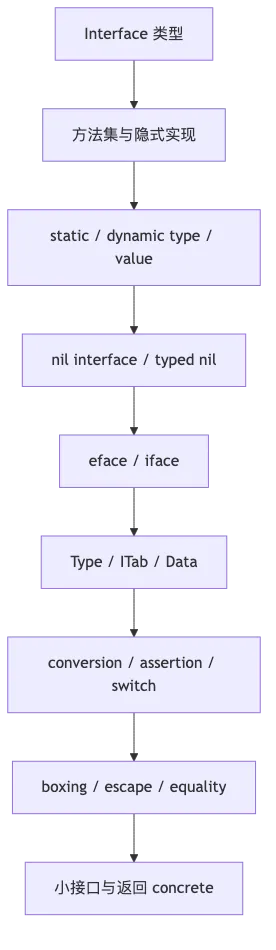
读图时抓住三个总结:
- 接口的语言语义是方法集合,运行期值模型则是“类型信息 + 数据”的组合。
nil interface、typed nil、装箱和比较 panic,本质上都来自 dynamic type/value 的边界。- 好的接口设计要小、稳定、靠近消费者;返回 concrete 往往比提前暴露大接口更稳。
一、本章面试目标
本章要建立这条知识链:
Interface 语言语义
→ Static Type / Dynamic Type / Dynamic Value
→ nil interface 与 typed nil
→ method set 与隐式实现
→ empty interface / non-empty interface / any
→ eface / iface / EmptyInterface / NonEmptyInterface
→ ITab / Type / Data
→ interface conversion / assertion / type switch
→ boxing / escape / direct interface / indirect interface
→ interface equality / map key 风险
→ API 设计:小接口、消费者定义接口、返回 concrete
→ 泛型、反射、函数参数与 interface 的选择
→ 生产故障与排查
→ 面试表达
1. 初级面试必须掌握
- interface 是一组方法集合。
- Go 是隐式实现接口,不需要
implements。 interface{}和any可以接收任意类型。nil interface和“接口里装了一个 nil 指针”不是一回事。- 类型断言有单返回值和 comma-ok 两种写法。
- pointer receiver 和 value receiver 会影响是否实现接口。
- 给已发布接口增加方法会破坏实现方兼容性。
2. 中高级面试必须掌握
- interface 变量有 static type、dynamic type、dynamic value。
- empty interface 和 non-empty interface 当前 runtime 布局不同。
iface依赖ITab,eface依赖 concreteType。- interface 调用是动态派发,但不一定慢,可能被 devirtualization / inlining 优化。
- interface boxing 是否分配,要结合逃逸分析、direct interface、value size、调用边界判断。
- interface 比较会检查 dynamic type 和 dynamic value,可比较性不足会 panic。
map[interface{}]V能编译,但运行时可能因 key 的动态值不可比较而 panic。
3. 高级 / 源码级面试可能追问
internal/abi.ITab的Inter、Type、Hash、Fun分别干什么。getitab如何查找 / 创建 / 缓存 interface-concrete 映射。- 编译器如何把 concrete-to-interface 转换 lowering 成
OMAKEFACE。 convT、convTnoptr、convT16、convT32、convT64、convTstring、convTslice分别解决什么。- type assertion 如何走
assertE2I、assertE2I2、typeAssert。 - interface equality 为什么会走
efaceeq/ifaceeq。 - constraint interface 和 runtime interface value 的区别。
- interface、泛型、反射、函数参数在 API 设计上的取舍。
二、功能介绍与语言语义
1. Interface 是什么
Go 规范中,interface type 定义的是一个 type set。接口变量可以保存任何属于该 type set 的类型的值;未初始化的 interface 变量值是 nil。(go.dev)
type Reader interface {
    Read(p []byte) (n int, err error)
}
只要某个类型的方法集包含:
Read([]byte) (int, error)它就实现了 Reader。
Go 的接口实现是:
结构化匹配
而不是名义声明
所以不需要:
implements Reader而是只要方法集满足即可。
2. Static Type、Dynamic Type、Dynamic Value
Go 规范明确区分变量的 static type 与 interface 变量的 dynamic type。interface 变量的 static type 是声明时的接口类型;dynamic type 是运行时实际装入的非接口类型;如果赋值的是 nil,则没有 dynamic type。规范中的例子也直接展示了 x = v 后,x 的 dynamic type 是 *T,即使 v 本身是 nil 指针。(go.dev)
var x any        // static type: interface{}
var p *int = nil // static type: *int, value: nil

x = p
此时:
x 的 static type  = any
x 的 dynamic type = *int
x 的 dynamic value = nil pointer
x == nil ? false
这就是 typed nil 的根源。
3. nil Interface 与 Typed Nil Interface
nil interface
var x any
fmt.Println(x == nil) // true
此时 interface 的两个核心字都为空:
type word = nil
data word = nil
typed nil interface
var p *int = nil
var x any = p

fmt.Println(x == nil) // false
此时:
type word = *int 的类型描述符
data word = nil
所以它不是 nil interface。
4. Typed Nil Error Bug
最经典的坑:
type MyError struct {
    msg string
}

func (e *MyError) Error() string {
    return e.msg
}

func bad() error {
    var e *MyError = nil
    return e
}

func main() {
    err := bad()
    fmt.Println(err == nil) // false
}
原因:
return e把 *MyError(nil) 装进了 error interface。
结果不是:
nil error而是:
error{
    dynamic type  = *MyError
    dynamic value = nil
}
所以 err != nil。
正确写法:
func good() error {
    var e *MyError = nil
    if e == nil {
        return nil
    }
    return e
}
面试表达:
Go 判断 interface 是否为 nil,看的是整个 interface value 是否为 nil,而不是它内部 dynamic value 是否为 nil。
*MyError(nil)转成error后 dynamic type 不为空,所以err != nil。
5. Empty Interface、Non-empty Interface、any
empty interface
interface{}空接口 type set 包含所有非接口类型;any 是 interface{} 的预声明别名,Go 1.18 引入。(go.dev)
var x interface{}
var y any
二者完全等价。
non-empty interface
type Stringer interface {
    String() string
}
它要求 dynamic type 的 method set 至少包含 String() string。
6. Basic Interface、General Interface、Constraint Interface
Go 1.18 之后,interface 不只可以写方法,也可以写 type terms:
type Integer interface {
    ~int | ~int64 | ~uint
}
这类带 type terms 的接口叫 general interface。规范规定:非 basic interface 只能作为类型约束,不能作为普通变量类型。(go.dev)
type Number interface {
    ~int | ~float64
}

var x Number // 编译错误:Number 不是 basic interface
这点面试很重要:
运行时 interface value
≠ 泛型 constraint interface
运行时 interface value 是两个 word 的动态值。
泛型 constraint interface 是编译期用于约束类型参数的类型集合。
7. Method Set 与接口实现
规范定义 method set:
- defined type
T的方法集包含 receiver 为T的方法; *T的方法集包含 receiver 为T和*T的方法;- interface 的方法集通常就是它声明的方法集合。(go.dev)
type I interface {
    M()
}

type T struct{}

func (T) M() {}

var _ I = T{}  // ok
var _ I = &T{} // ok
如果方法是 pointer receiver:
type T struct{}

func (*T) M() {}

var _ I = T{}  // 编译错误
var _ I = &T{} // ok
原因:
T 的 method set 不包含 M
*T 的 method set 包含 M
三、底层实现
1. 规范与实现要分开
| 维度 | 内容 |
|---|---|
| Go 规范保证 | interface type set、method set、type assertion、type switch、comparison 行为 |
| 当前 runtime 实现 | EmptyInterface / NonEmptyInterface / ITab / Type / Data |
| 当前 compiler 实现 | OCONVIFACE、OMAKEFACE、convT*、typeAssert |
| 工程经验 | interface 是否分配、是否慢,要 benchmark 和 escape analysis 判断 |
2. 当前源码中的 interface 布局
当前 Go 源码在 src/internal/abi/iface.go 中定义了三类结构:
type EmptyInterface struct {
    Type *Type
    Data unsafe.Pointer
}

type NonEmptyInterface struct {
    ITab *ITab
    Data unsafe.Pointer
}
源码注释说明:empty interface 的第一个 word 指向 abi.Type;non-empty interface 的第一个 word 指向 ITab。(go.dev)
可以抽象为:
empty interface / any:

+---------+---------+
| *Type   | Data    |
+---------+---------+

non-empty interface:

+---------+---------+
| *ITab   | Data    |
+---------+---------+
历史面经常说:
eface = empty interface
iface = non-empty interface
这个术语仍然便于解释,但当前更准确的源码名是:
internal/abi.EmptyInterface
internal/abi.NonEmptyInterface
3. ITab 结构
当前 ITab:
type ITab struct {
    Inter *InterfaceType
    Type  *Type
    Hash  uint32
    Fun   [1]uintptr
}
源码注释说明:non-empty interface 的第一个 word 是 *ITab;ITab 记录 interface type、underlying concrete type 以及辅助信息。(go.dev)
含义:
| 字段 | 作用 |
|---|---|
Inter | 目标 interface 类型,例如 io.Reader |
Type | concrete dynamic type,例如 *bytes.Buffer |
Hash | concrete type hash 的拷贝,主要用于 type switch |
Fun | 方法表,存放 concrete type 实现 interface 方法的函数入口 |
示意图:
var r io.Reader = bytes.NewBuffer(nil)

r:
+------------------+------------------+
| *ITab            | Data             |
+------------------+------------------+
        |                    |
        v                    v
+-------------------------+  *bytes.Buffer object
| Inter = *io.Reader type |
| Type  = *bytes.Buffer   |
| Hash  = ...             |
| Fun[0] = (*Buffer).Read |
+-------------------------+
调用:
r.Read(p)大致过程:
1. 从 interface 第一个 word 拿到 ITab
2. 根据方法偏移找到 Fun[i]
3. 把 Data 作为 receiver 传入
4. 调用具体函数
4. Type 结构与 InterfaceType
src/internal/abi/type.go 中的 Type 是运行时类型元数据的核心结构;InterfaceType 包含嵌入的 Type、包路径和方法集合。源码还提供 IsDirectIface 判断某类型是否直接存入 interface data word。(go.dev)
Type:
- Size
- PtrBytes
- Hash
- TFlag
- Align
- Kind
- Equal
- GCData
- Str
- PtrToThis
...

InterfaceType:
- Type
- PkgPath
- Methods
注意:
Type 是 runtime 类型描述符
不是 reflect.Type 接口本身
reflect.Type 是公开 API 层;底层通过 runtime 类型元数据支撑。
5. Concrete → Interface
var x any = 123当前编译器会处理为:
type word = int 的 Type
data word = 123 的数据地址或直接值
在 src/cmd/compile/internal/walk/convert.go 中,walkConvInterface 会处理 OCONVIFACE,对 non-interface 到 interface 的转换构造 OMAKEFACE,其中第一个参数是 type word,第二个参数是 data word。(go.dev)
抽象流程:
Concrete value
    |
    | compiler lowering
    v
OMAKEFACE(typeWord, dataWord)
    |
    v
interface value
6. dataWord:什么时候分配,什么时候不分配
这是 interface 性能面试的核心。
当前编译器 dataWord 的逻辑大致是:
- 如果类型可 direct interface,直接用原值作为 data word。
- zero-size value 可以用全局
zerobase。 - bool / byte / 小整数可能用静态表。
- 只读全局值可直接引用。
- 如果不逃逸且大小不超过阈值,可用栈临时变量。
- 否则调用 runtime
convT*进行转换,可能堆分配。(go.dev)
源码中 dataWordFuncName 会根据类型大小、对齐、是否含指针、是否 string / slice 等选择 convT16、convT32、convT64、convTstring、convTslice、convT、convTnoptr。(go.dev)
所以不能简单说:
interface 一定分配准确表达是:
concrete value 装箱进 interface 时是否分配,取决于 dynamic value 的类型表示、是否 direct interface、是否逃逸、大小、是否可用静态数据或栈临时变量。必须用
-gcflags=-m、benchmark 和 pprof 验证。
7. Direct Interface 与 Indirect Interface
当前源码中 Type.IsDirectIface() 通过 TFlagDirectIface 判断类型是否直接存入 interface value。(go.dev)
可以理解为:
Direct interface:
Data word 本身就是值或指针形态的值

Indirect interface:
Data word 指向一份保存 dynamic value 的内存
例子:
var p *int
var x any = p
pointer 是 pointer-shaped,通常可以直接放入 data word。
type Big struct {
    A, B, C, D int64
}

var b Big
var x any = b
大 struct 一般需要复制到某处,然后 data word 指向它。
8. runtime convT
runtime 中的 convT 会分配一块内存,把值复制进去,并返回可作为 interface 第二个 word 的指针。源码中 convT 调用 mallocgc,再 typedmemmove;convTnoptr 则针对不含指针的类型走 memmove。(go.dev)
convT:
mallocgc(size, type, true)
typedmemmove(type, dst, src)

convTnoptr:
mallocgc(size, type, false)
memmove(dst, src, size)
面试表达:
interface 装箱的本质是构造 type word 和 data word。data word 可能直接保存 pointer-shaped value,也可能指向一份复制出来的对象。是否堆分配由编译器逃逸分析和 lowering 结果决定。
9. Interface → Interface
var r io.Reader = buf
var x any = r
non-empty interface 转 empty interface 时:
从 ITab 中拿 concrete Type
保留 Data
构造 EmptyInterface{Type, Data}
源码中的 walkConvInterface 对 interface-to-empty-interface 有专门逻辑:取 itab 和 data,如果 itab != nil,取出 itab.type,然后构造 OMAKEFACE。(go.dev)
non-empty interface 转另一个 non-empty interface:
var r io.Reader = buf
var s fmt.Stringer = r
需要判断 dynamic type 是否实现目标 interface,当前实现会走类似 type assertion 的路径。
10. Interface → Concrete:Type Assertion
v := x.(int)规范规定:对 interface 表达式 x 和类型 T,x.(T) 断言 x 非 nil,并且 x 存储的值类型为 T;如果 T 是 interface,则断言 dynamic type 实现 T。(go.dev)
两种形式:
v := x.(int)      // 失败 panic
v, ok := x.(int)  // 失败 ok=false
runtime 中 assertE2I 对 nil 输入会 panic,assertE2I2 对 nil 输入返回 nil;typeAssert 会根据 CanFail 决定失败时 panic 还是返回 nil。(go.dev)
11. Type Switch
switch v := x.(type) {
case nil:
case int:
case string:
default:
}
规范规定 type switch 比较的是 dynamic type;case nil 只匹配 nil interface value。(go.dev)
注意:
var p *int = nil
var x any = p

switch x.(type) {
case nil:
    fmt.Println("nil")
case *int:
    fmt.Println("*int")
}
输出:
*int因为 x 不是 nil interface,而是 dynamic type 为 *int 的 interface。
12. getitab 与 ITab 缓存
runtime.getitab 负责根据:
interface type + concrete type找到或创建 ITab。
当前源码流程:
- 如果 concrete type 没有 uncommon method data,快速失败。
- 无锁读取全局 itab table。
- 找不到则加锁再查一次。
- 仍找不到则 persistent allocate 一个新 itab。
- 初始化 method table。
- 加入 itab table。
- 如果
Fun[0] == 0,表示不实现接口。(go.dev)
itab table 的查找使用二次探测;表负载达到 75% 时扩容。(go.dev)
面试表达:
ITab 是 non-empty interface 动态派发的桥。它把“某个具体类型是否实现某个接口”这件事缓存下来,并保存方法入口表,避免每次调用都重新匹配方法集合。
13. Interface Equality
规范规定:两个 interface value 比较时,如果 dynamic type 相同但该 dynamic type 不可比较,会运行时 panic;slice、map、function 不可比较,只能和 nil 比较。(go.dev)
var a any = []int{1}
var b any = []int{1}

fmt.Println(a == b) // panic
runtime 中:
- empty interface 比较走
efaceeq - non-empty interface 比较走
ifaceeq - 如果类型没有 equality function,panic
- direct interface 类型可直接比较 data word,否则调用类型专属 equality function。(go.dev)
14. Interface 作为 Map Key 的风险
规范规定 map key 类型必须支持 == 和 !=;如果 key 是 interface type,则要求 dynamic key values 可比较,否则会 panic。(go.dev)
m := map[any]int{}

m["a"] = 1       // ok
m[123] = 2       // ok
m[[]int{1}] = 3  // panic: hash of unhashable type []int
面试表达:
map[interface{}]V的 key 类型在编译期是可比较的,但真正 hash 和 equal 时要看 dynamic value。dynamic value 如果是 slice、map、func,会运行时 panic。
15. nil Pointer Receiver 经 Interface 调用
type T struct{}

func (*T) M() {
    fmt.Println("M")
}

func main() {
    var p *T = nil
    var i interface{ M() } = p

    i.M() // 可以进入方法,是否 panic 取决于方法内部是否解引用 receiver
}
这里 i 非 nil,因为 dynamic type 是 *T。
如果方法内部不解引用 receiver,可以正常执行。
func (t *T) M() {
    fmt.Println(t == nil)
}
输出:
true但如果:
func (t *T) M() {
    fmt.Println(t.Name)
}
则会因 nil pointer dereference panic。
规范也规定:nil interface 上调用方法会 panic。(go.dev)
var i interface{ M() }
i.M() // panic
四、源码阅读路径
1. 语言规范
优先读:
Go Specification
- Interface types
- Implementing an interface
- Method sets
- Type assertions
- Type switches
- Comparison operators
重点结论:
| 章节 | 重点 |
|---|---|
| Interface types | type set、basic interface、general interface |
| Implementing an interface | 隐式实现规则 |
| Method sets | value receiver / pointer receiver |
| Type assertions | x.(T) 成功和失败条件 |
| Type switches | dynamic type 匹配 |
| Comparison operators | interface 比较和 panic 条件 |
2. runtime / internal/abi
src/internal/abi/iface.go
重点看:
type ITab struct
type EmptyInterface struct
type NonEmptyInterface struct
type CommonInterface struct
它给出当前 interface value 的基本布局。(go.dev)
src/internal/abi/type.go
重点看:
type Type struct
func (t *Type) IsDirectIface() bool
type InterfaceType struct
它解释 runtime 如何描述类型、接口方法集合、direct interface 标记。(go.dev)
src/runtime/iface.go
重点看:
getitab
itabHashFunc
itabTableType.find
itabAdd
itabInit
assertE2I
assertE2I2
typeAssert
convT
convTnoptr
convT16
convT32
convT64
convTstring
convTslice
阅读顺序:
1. ITab 布局
2. getitab 查找流程
3. itabInit 方法匹配
4. assertE2I / assertE2I2
5. typeAssert 缓存
6. convT* 装箱分配
src/runtime/alg.go
重点看:
efaceeq
ifaceeq
interequal
nilinterequal
efaceHash
ifaceHash
可推导出 interface 比较和 map key panic 的原因。(go.dev)
3. compiler
src/cmd/compile/internal/walk/convert.go
重点看:
walkConvInterface
dataWord
dataWordFuncName
它解释 concrete-to-interface 如何 lowering,以及何时用栈、静态数据或 runtime conv 函数。(go.dev)
src/cmd/compile/internal/typecheck/builtin.go
重点看 runtime helper 注册:
convT
convTnoptr
convT16
convT32
convT64
convTstring
convTslice
assertE2I
assertE2I2
panicdottypeE
panicdottypeI
typeAssert
interfaceSwitch
ifaceeq
efaceeq
这些是编译器可能生成调用的 runtime helper。(go.dev)
src/cmd/compile/internal/ssagen/ssa.go
重点看:
OCALLINTER
ODOTINTER
getClosureAndRcvr
dottype
callResult
interface method call 在 SSA 阶段会走 OCALLINTER,加载方法入口并传入 receiver。(go.dev)
五、常用场景与工程取舍
场景 1:小接口抽象行为
type Clock interface {
    Now() time.Time
}
适合:
- 测试可替换。
- 业务只依赖行为,不依赖具体实现。
- 接口方法少,语义稳定。
不适合:
- 方法太多。
- 还没出现第二个实现就提前抽象。
- 抽象泄漏底层细节。
替代方案:
func now func() time.Time或直接传函数。
场景 2:消费者定义接口
推荐:
package service

type UserRepo interface {
    GetByID(ctx context.Context, id int64) (*User, error)
}
不推荐让 provider 包定义大接口:
package mysqlrepo

type Repository interface {
    GetByID(...)
    Create(...)
    Update(...)
    Delete(...)
    BatchUpsert(...)
    Tx(...)
}
原则:
接口应该由使用方定义,而不是由实现方提前定义一个“全家桶接口”。
场景 3:返回 concrete,接收 interface
推荐:
func NewClient(...) *Client而不是:
func NewClient(...) ClientInterface原因:
- 返回 concrete 保留扩展能力。
- 使用方可以自行定义需要的接口。
- 避免接口锁死 API。
- 避免 mock 为了满足巨大接口而臃肿。
经典表达:
Accept interfaces, return structs.但不是绝对规则。如果你要隐藏实现,例如 plugin、driver、remote client,也可以返回 interface。
场景 4:error 接口
error 是最重要的接口之一:
type error interface {
    Error() string
}
使用风险:
- typed nil error。
- 包装后丢失 sentinel。
- 错误字符串判断。
errors.Is/errors.As使用不当。
建议:
if err != nil {
    return fmt.Errorf("query user: %w", err)
}
需要类型判断时:
var target *MyError
if errors.As(err, &target) {
    ...
}
场景 5:interface 与泛型
interface 适合:
运行时多态
异构集合
mock / fake
插件式扩展
泛型适合:
同构算法
容器
避免 interface{} + type assertion
编译期类型安全
例子:
func Max[T constraints.Ordered](a, b T) T比:
func Max(a, b any) any更安全、更少运行时判断。
场景 6:interface 与 reflection
反射适合:
- 序列化。
- ORM。
- 通用配置解析。
- 动态字段处理。
interface 适合:
- 稳定行为抽象。
- 多实现切换。
- 测试替换。
不要用 reflect 解决本来可以用 interface 解决的问题。
六、代码陷阱题
题 1:nil interface
package main

import "fmt"

func main() {
    var x any
    fmt.Println(x == nil)
}
答案:
true分析:
x 是未初始化的 interface,type word 和 data word 都是 nil。
追问:
如果
var p *int = nil; x = p呢?
题 2:typed nil pointer
package main

import "fmt"

func main() {
    var p *int = nil
    var x any = p
    fmt.Println(x == nil)
}
答案:
false分析:
x 的 dynamic type 是 *int,dynamic value 是 nil pointer。
题 3:typed nil error
package main

import "fmt"

type MyErr struct{}

func (*MyErr) Error() string { return "bad" }

func f() error {
    var e *MyErr = nil
    return e
}

func main() {
    err := f()
    fmt.Println(err == nil)
}
答案:
false分析:
return e 触发 *MyErr 到 error 的转换。
题 4:返回真正的 nil error
func f(ok bool) error {
    var e *MyErr = nil
    if ok {
        return nil
    }
    return e
}
当 ok=true:
返回 nil interface当 ok=false:
返回 dynamic type = *MyErr, dynamic value = nil所以:
fmt.Println(f(true) == nil)  // true
fmt.Println(f(false) == nil) // false
题 5:slice 动态值比较
package main

import "fmt"

func main() {
    var a any = []int{1}
    var b any = []int{1}
    fmt.Println(a == b)
}
答案:
panic原因:
interface 可以比较,但 dynamic type []int 不可比较。规范明确规定 dynamic type 相同且不可比较时会 panic。(go.dev)
题 6:interface 作为 map key
package main

func main() {
    m := map[any]int{}
    m[[]int{1}] = 1
}
答案:
panic: hash of unhashable type []int分析:
map[any]int 编译通过,但插入时要 hash dynamic value。
题 7:value receiver 实现接口
type I interface{ M() }

type T struct{}

func (T) M() {}

var _ I = T{}
var _ I = &T{}
答案:
都能编译分析:
T 的方法集有 M,*T 的方法集也包含 receiver 为 T 的方法。
题 8:pointer receiver 实现接口
type I interface{ M() }

type T struct{}

func (*T) M() {}

var _ I = T{}
答案:
编译错误分析:
T 的 method set 不包含 M,只有 *T 包含。
题 9:nil pointer receiver 经 interface 调用
package main

import "fmt"

type I interface{ M() }

type T struct{}

func (t *T) M() {
    fmt.Println(t == nil)
}

func main() {
    var p *T = nil
    var i I = p
    i.M()
}
答案:
true分析:
interface 非 nil,方法可调用;receiver 是 nil pointer。
题 10:nil interface 调用方法
type I interface{ M() }

func main() {
    var i I
    i.M()
}
答案:
panic分析:
nil interface 没有 ITab,无法动态派发。
题 11:单返回值断言失败
package main

func main() {
    var x any = "hello"
    _ = x.(int)
}
答案:
panic分析:
单返回值断言失败会 panic。
题 12:comma-ok 断言失败
package main

import "fmt"

func main() {
    var x any = "hello"
    v, ok := x.(int)
    fmt.Println(v, ok)
}
答案:
0 false分析:
断言失败时返回目标类型零值和 false。
题 13:type switch 中的 nil
package main

import "fmt"

func main() {
    var p *int = nil
    var x any = p

    switch x.(type) {
    case nil:
        fmt.Println("nil")
    case *int:
        fmt.Println("*int")
    }
}
答案:
*int分析:
case nil 只匹配 nil interface,不匹配 typed nil。
题 14:interface 保存值副本
package main

import "fmt"

type User struct {
    Name string
}

func main() {
    u := User{Name: "A"}
    var x any = u
    u.Name = "B"
    fmt.Println(x.(User).Name)
}
答案:
A分析:
struct value 装入 interface 时复制了一份。
题 15:interface 保存 pointer
package main

import "fmt"

type User struct {
    Name string
}

func main() {
    u := &User{Name: "A"}
    var x any = u
    u.Name = "B"
    fmt.Println(x.(*User).Name)
}
答案:
B分析:
interface 保存的是 pointer value,指向同一个对象。
题 16:不能直接修改 interface 中的 struct 字段
type User struct {
    Name string
}

func main() {
    var x any = User{Name: "A"}
    x.(User).Name = "B"
}
答案:
编译错误分析:
x.(User) 的结果不是可寻址变量,不能直接赋字段。
正确写法:
u := x.(User)
u.Name = "B"
x = u
题 17:compile-time assertion
type I interface{ M() }

type T struct{}

func (*T) M() {}

var _ I = (*T)(nil)
答案:
编译通过分析:
这是编译期检查 *T 是否实现 I,不会创建运行时对象。
题 18:接口增加方法
type Store interface {
    Get(id int64) string
}
发布后改成:
type Store interface {
    Get(id int64) string
    Set(id int64, v string)
}
答案:
可能破坏所有已有实现分析:
Go 接口是结构化匹配,所有只实现 Get 的类型都会不再满足新接口。
题 19:general interface 不能作为普通变量类型
type Number interface {
    ~int | ~int64
}

var x Number
答案:
编译错误分析:
带 type terms 的非 basic interface 只能作为类型约束。(go.dev)
题 20:NaN 动态值
package main

import (
    "fmt"
    "math"
)

func main() {
    var a any = math.NaN()
    var b any = math.NaN()
    fmt.Println(a == b)
}
答案:
false分析:
dynamic type 都是 float64,可比较;但 NaN != NaN,所以 interface 比较结果也是 false。
七、面试高频问题
1. interface 是什么?
30 秒回答:
interface 是一组方法约束。某个类型只要方法集满足接口要求,就隐式实现该接口。
中高级回答:
Go 1.18 后,从规范角度 interface 定义的是 type set。basic interface 的 type set 由方法集合决定;general interface 可以包含 type terms,但只能用于约束。
源码级回答:
runtime 中 empty interface 当前是
Type + Data,non-empty interface 当前是ITab + Data。non-empty interface 通过 ITab 保存 interface type、concrete type 和方法表。
常见错误:
“interface 就是 Java interface。”
不准确。Go 没有显式 implements,且接口可由使用方定义。
2. interface{} 和 any 有什么区别?
没有语义区别。any 是 interface{} 的 alias。规范明确说明 any 是 empty interface 的预声明别名。(go.dev)
3. nil interface 和 typed nil 的区别?
核心:
nil interface:
type=nil, data=nil

typed nil:
type=*T, data=nil
所以:
var p *T = nil
var x any = p
x == nil // false
4. 为什么 typed nil error 会出 bug?
因为返回 *MyError(nil) 到 error 时,interface 的 dynamic type 是 *MyError,不是 nil interface。
5. interface 底层是两个指针吗?
更准确:
当前实现中 interface value 是两个 word。empty interface 是
*Type + Data,non-empty interface 是*ITab + Data。Data 是unsafe.Pointer形态,但可能保存的是直接值的指针形态表示,也可能指向复制后的对象。(go.dev)
不要说成永久语言保证。
6. eface 和 iface 是什么?
历史术语:
eface = empty interface
iface = non-empty interface
当前源码更推荐看:
internal/abi.EmptyInterface
internal/abi.NonEmptyInterface
7. ITab 是什么?
ITab 是 non-empty interface 动态派发的核心结构,包含:
Inter: interface type
Type: concrete type
Hash: type hash
Fun: method table
源码字段在 internal/abi.ITab 中。(go.dev)
8. interface 调用一定慢吗?
不一定。
影响因素:
- 是否动态派发。
- 是否逃逸。
- 是否能 devirtualize。
- 是否能 inline。
- hot path 调用频率。
- concrete type 是否可在编译期确定。
结论必须通过:
go test -bench=. -benchmem
go build -gcflags='-m=2'
go test -cpuprofile cpu.out
判断。
9. interface 装箱一定分配吗?
不一定。
当前编译器可能:
- direct interface,不分配。
- 用静态全局。
- 用栈临时变量。
- 调 runtime
convT*堆分配。
dataWord 源码能看到这些分支。(go.dev)
10. type assertion 和 type switch 的区别?
type assertion 判断一个目标类型:
v, ok := x.(T)type switch 判断多个类型:
switch v := x.(type) {}二者都基于 interface dynamic type。
11. 为什么 interface 比较会 panic?
因为 interface 自身可比较,但 dynamic value 可能不可比较。
var x any = []int{1}
fmt.Println(x == x) // panic规范对此有明确说明。(go.dev)
12. map[any]V 有什么坑?
编译期允许,但 key 的 dynamic value 必须 hashable / comparable。
m[[]int{1}] = 1 // panic13. value receiver 和 pointer receiver 如何影响接口实现?
T 的 method set:     只有 receiver T 的方法
*T 的 method set:    receiver T + receiver *T 的方法
所以 pointer receiver 方法只有 *T 实现接口。
14. nil pointer receiver 可以调用吗?
可以,只要 interface 非 nil,是否 panic 取决于方法内部是否解引用 nil receiver。
15. 为什么推荐小接口?
因为小接口:
- 更稳定。
- 更易 mock。
- 更少破坏兼容性。
- 更符合使用方视角。
- 更不容易泄漏实现细节。
16. 为什么推荐返回 concrete?
因为返回 concrete:
- 保留实现类型的完整能力。
- 调用方可以自行抽象接口。
- 避免锁死 API。
- 避免未来扩展困难。
17. interface 和泛型怎么选?
| 场景 | 选择 |
|---|---|
| 运行时多态 | interface |
| mock / fake | interface |
| 容器 / 算法 | 泛型 |
| 编译期类型安全 | 泛型 |
| 异构集合 | interface |
| 序列化 / ORM | reflection + interface |
18. constraint interface 和普通 interface 一样吗?
不一样。
type Number interface {
    ~int | ~int64
}
这是类型约束,不是运行时 interface value 类型。
19. var _ Interface = (*T)(nil) 有什么用?
用于编译期断言:
var _ io.Reader = (*MyReader)(nil)如果 *MyReader 没实现 io.Reader,编译失败。
20. 给接口增加方法为什么危险?
因为 Go 接口是结构化匹配。接口增加方法后,所有旧实现都可能不再满足接口。
八、深挖追问链
追问链 1:从 interface 语义到 typed nil
-
interface 是什么? 一组方法约束;Go 1.18 后规范上是 type set。
-
什么叫隐式实现? 类型方法集满足接口即可,不需要声明 implements。
-
interface 变量里有什么? static type 是接口类型,dynamic type 是运行时装入的具体类型,dynamic value 是具体值。
-
nil interface 是什么? dynamic type 和 dynamic value 都没有。
-
typed nil 是什么? dynamic type 存在,但 dynamic value 是 nil。
-
typed nil error 怎么避免? 返回前显式判断 typed nil,真正返回
nil。
追问链 2:从 eface/iface 到 ITab
-
empty interface 当前如何表示?
Type + Data。 -
non-empty interface 当前如何表示?
ITab + Data。 -
为什么 non-empty interface 不直接用 Type? 因为还需要保存 concrete type 针对该 interface 的方法表。
-
ITab 里有什么? interface type、concrete type、hash、method table。
-
方法调用怎么发生? 通过 ITab 找到 Fun 中的方法入口,把 Data 作为 receiver。
-
ITab 如何生成? 由
getitab查找或创建,并由itabInit填充方法表。
追问链 3:从装箱到逃逸
-
什么是 boxing? concrete value 转 interface value 的过程。
-
boxing 一定分配吗? 不一定。
-
什么时候不分配? direct interface、静态数据、栈临时、不逃逸等情况。
-
什么时候可能分配? 大值、跨函数逃逸、返回 interface、存入 heap object 等。
-
怎么证明?
go build -gcflags='-m=2'看逃逸,go test -benchmem看 allocs/op。 -
怎么优化? 避免 hot path 中频繁装箱大对象;必要时用泛型、具体类型或函数参数。
追问链 4:从 assertion 到 type switch
-
type assertion 做什么? 判断 interface dynamic type 是否为某类型或实现某接口。
-
单返回值失败怎样? panic。
-
comma-ok 失败怎样? 返回零值和 false。
-
interface-to-interface assertion 是什么? 判断 dynamic type 是否实现目标接口。
-
type switch 匹配什么? dynamic type。
-
case nil 匹配 typed nil 吗? 不匹配,只匹配 nil interface。
追问链 5:从 API 设计到兼容性
-
接口应该定义在哪里? 多数情况下由消费者定义。
-
接口应该大还是小? 小。
-
为什么不推荐返回接口? 容易锁死 API,调用方难以扩展。
-
什么时候可以返回接口? 隐藏实现、插件系统、driver、远程代理。
-
接口增加方法为什么破坏兼容? 旧实现不再满足接口。
-
泛型出现后 interface 过时了吗? 没有。泛型解决编译期类型参数问题,interface 解决运行时多态问题。
九、生产故障与排查
故障 1:typed nil error 导致错误分支误触发
现象:
err := service.Do()
if err != nil {
    alarm()
}
明明没有真实错误,却进入错误分支。
排查:
- 打印:
fmt.Printf("%T %[1]v\n", err)- 检查返回函数是否返回了
*CustomError(nil)。 - 用单测覆盖:
if got := f(); got != nil {
    t.Fatalf("expected nil, got %T", got)
}
解决:
if e == nil {
    return nil
}
return e
故障 2:map[any]V 线上 panic
现象:
panic: hash of unhashable type []string原因:
interface key 的 dynamic value 是 slice / map / func。
排查:
- 搜索
map[interface{}]、map[any]。 - panic 堆栈定位插入点。
- 打印 key dynamic type。
- 对 key 类型做白名单。
解决:
type CacheKey struct {
    TenantID string
    UserID   int64
}
不要用任意 any 当 key。
故障 3:interface 装箱导致 allocs/op 升高
现象:
BenchmarkX-8 1000000 1200 ns/op 512 B/op 8 allocs/op排查:
go test -bench=. -benchmem
go build -gcflags='-m=2'
看是否出现:
x escapes to heap解决方向:
- hot path 避免返回
any。 - 避免把大 struct 频繁装入 interface。
- 使用泛型。
- 使用具体类型。
- 指针传递,但要注意共享可变状态。
- 用 benchmark 验证优化。
故障 4:interface 抽象过大导致 mock 臃肿
现象:
type Repository interface {
    Get()
    Create()
    Update()
    Delete()
    Tx()
    Batch()
    Search()
    Export()
}
测试一个函数却要 mock 八个方法。
解决:
在消费者处定义最小接口:
type UserGetter interface {
    GetUser(ctx context.Context, id int64) (*User, error)
}
故障 5:nil pointer receiver panic
现象:
panic: runtime error: invalid memory address or nil pointer dereferenceinterface 不为 nil,但 receiver 为 nil。
排查:
fmt.Printf("%T %#v\n", i, i)解决:
func (t *T) M() {
    if t == nil {
        return
    }
}
或者避免把 nil pointer 装入 interface。
工具选择
| 工具 | 能证明什么 | 不能证明什么 |
|---|---|---|
go test -race | data race | 不能证明无所有并发问题 |
go test -benchmem | allocs/op、B/op | 不能解释为什么分配 |
go build -gcflags='-m=2' | 逃逸原因 | 不直接说明业务瓶颈 |
pprof | CPU / heap 热点 | 需要压测流量代表真实场景 |
go tool objdump | 是否存在间接调用、runtime helper | 阅读成本高 |
go tool trace | 调度、阻塞、GC 影响 | 不直接定位所有代码级原因 |
runtime/metrics | 运行时指标趋势 | 需要配合业务标签 |
| 日志 | dynamic type、错误路径 | 可能影响性能,注意采样 |
十、面试回答模板
1. 30 秒回答
Go interface 是一组方法约束,类型只要方法集满足接口就隐式实现。interface 变量有 static type、dynamic type 和 dynamic value。nil interface 和装了 typed nil 的 interface 不一样,这是 typed nil error bug 的根源。
2. 2 分钟回答
从规范上看,Go 1.18 后 interface 定义的是 type set。basic interface 主要由方法集合组成,general interface 可以包含 type terms,但只能用于泛型约束。运行时当前实现里,empty interface 是
Type + Data,non-empty interface 是ITab + Data。ITab 记录 interface type、concrete type 和方法表,所以 interface 方法调用可以通过 ITab 做动态派发。interface 转换、断言、比较都围绕 dynamic type 和 dynamic value 展开。
3. 5 分钟深入回答
concrete value 转 interface 时,本质是构造 type word 和 data word。empty interface 的 type word 是 concrete type;non-empty interface 的 type word 是 ITab。Data word 可能直接保存 pointer-shaped value,也可能指向一份复制出来的值。是否分配不绝对,编译器会根据 direct interface、逃逸分析、value size、静态值、栈临时等做优化。类型断言会检查 dynamic type,失败时单返回值 panic,comma-ok 返回 false。interface 比较时,如果 dynamic type 相同但不可比较,比如 slice,就会 panic。生产中最常见的坑是 typed nil error、map[any] key panic、接口过大、过早抽象以及 hot path 装箱分配。
4. 源码级回答
当前源码中 interface 相关结构在
internal/abi/iface.go,EmptyInterface是Type + Data,NonEmptyInterface是ITab + Data,ITab包含Inter、Type、Hash、Fun。runtime/iface.go的getitab负责查找或创建 interface-concrete 的映射,itabInit填充方法表。compiler 的walkConvInterface会把 concrete-to-interface lowering 成OMAKEFACE(typeWord, dataWord);dataWord决定是否使用 direct value、静态数据、栈临时或 runtimeconvT*。interface equality 在runtime/alg.go中走efaceeq/ifaceeq,不可比较 dynamic type 会 panic。
5. 生产事故分析回答
如果线上看到 interface 相关问题,我会先区分是语义问题、分配问题还是 API 设计问题。typed nil error 通过
%T打印 dynamic type 和单测确认;map[any] panic 通过堆栈定位 key dynamic type;性能问题用benchmem看 allocs/op,用-gcflags=-m=2看逃逸,用 pprof 看 CPU/heap 热点。修复上,语义问题优先调整返回 nil 的逻辑;性能问题避免 hot path 大对象装箱或改泛型;设计问题则拆小接口、消费者定义接口、返回 concrete。
十一、本章速记
- interface 的核心不是对象继承,而是方法集约束。
- Go 接口是隐式实现,不需要
implements。 - interface 变量有 static type、dynamic type、dynamic value。
- nil interface 是 type 和 data 都为空。
- typed nil 是 type 不为空、data 为空。
- typed nil error 是 Go 面试最高频坑之一。
any是interface{}的 alias。- empty interface 当前实现是
Type + Data。 - non-empty interface 当前实现是
ITab + Data。 - ITab 保存 interface type、concrete type 和 method table。
- interface method call 通过 ITab 动态派发。
- interface 装箱不一定堆分配。
- 是否分配要看 direct interface、逃逸和 compiler lowering。
- type assertion 单返回值失败 panic。
- comma-ok assertion 失败返回零值和 false。
- type switch 匹配 dynamic type。
case nil只匹配 nil interface,不匹配 typed nil。- interface 比较可能因 dynamic value 不可比较而 panic。
map[any]V的 key 运行时仍要求 dynamic value 可比较。- value receiver 方法让
T和*T都实现接口。 - pointer receiver 方法通常只有
*T实现接口。 - nil pointer receiver 可以被调用,但方法内部解引用会 panic。
- 小接口比大接口稳定。
- 接口通常由消费者定义。
- 一般推荐接收 interface,返回 concrete。
十二、自测题
简答题
- interface 的 static type、dynamic type、dynamic value 分别是什么?
- 为什么
var p *T = nil; var x any = p; x == nil是 false? - typed nil error bug 如何产生?
any和interface{}有什么区别?- empty interface 和 non-empty interface 当前 runtime 布局有什么区别?
- ITab 的作用是什么?
- interface 装箱一定堆分配吗?
- type assertion 单返回值和 comma-ok 有什么区别?
- 为什么
map[any]int可能 panic? - 为什么给接口增加方法会破坏兼容性?
代码题
代码题 1
var p *int = nil
var x any = p
fmt.Println(x == nil)
代码题 2
type I interface{ M() }
type T struct{}
func (*T) M() {}

var _ I = T{}
代码题 3
var a any = []int{1}
fmt.Println(a == a)
代码题 4
type E struct{}
func (*E) Error() string { return "e" }

func f() error {
    var e *E = nil
    return e
}
fmt.Println(f() == nil)
代码题 5
type User struct{ Name string }

u := User{Name: "A"}
var x any = u
u.Name = "B"
fmt.Println(x.(User).Name)
系统设计 / 生产故障题
- 线上出现大量
panic: hash of unhashable type []string,如何定位和修复? - 某个高频接口从
0 allocs/op变成3 allocs/op,你如何判断是否 interface 装箱导致? - 一个 repository interface 有 20 个方法,导致测试 mock 非常痛苦,你如何重构?
参考答案
简答题答案
- static type 是声明类型;dynamic type 是 interface 中运行时保存的具体类型;dynamic value 是具体值。
- 因为
x的 dynamic type 是*int,不是 nil interface。 - 返回
*CustomError(nil)到error,导致errordynamic type 不为空。 - 没区别,
any是interface{}的 alias。 - empty interface 当前是
Type + Data;non-empty interface 当前是ITab + Data。 - ITab 连接 interface type 和 concrete type,并保存方法表。
- 不一定,要看 direct interface、逃逸、大小、是否可用栈或静态数据。
- 单返回值失败 panic;comma-ok 失败返回零值和 false。
- dynamic key value 如果是 slice、map、func 等不可比较类型,运行时 panic。
- 旧实现可能不再满足新接口。
代码题答案
false。- 编译错误,
T没有实现I,只有*T实现。 - panic,因为 dynamic type 是不可比较的
[]int。 false,typed nil error。- 输出
A,因为 struct value 装入 interface 时复制了一份。
系统设计 / 故障题答案
- 查堆栈定位 map 写入点,打印 key dynamic type,替换成强类型 key。
- 用
benchmem确认分配,用-gcflags=-m=2看逃逸,用 pprof 看 heap 热点,再检查是否 concrete-to-interface 装箱。 - 按消费者拆小接口,删除 provider 侧大接口,测试只 mock 当前用到的方法。